Omaha Card Rankings

- Omaha High - Players and Cards - Deal and Betting - Showdown - Variations
- Five Card Omaha - Six-Card Omaha
Introduction
At PokerStars, we deal many varieties of poker, some of which use different hand rankings. Hold’em, Omaha, Seven Card Stud and Five Card Draw all use the traditional ‘high’ poker rankings. Omaha Hi/Lo, Razz and Stud Hi/Lo use the ‘Ace to Five’ (‘California’) low hand rankings for low hands. 2-7 Single Draw and 2-7 Triple Draw use the ‘Deuce to Seven’ (‘Kansas. Omaha High-Low 8 or Better. Omaha is very often played in such a way that the pot is split between the players with the highest and lowest hands. Since a low hand has to have no card higher than 8 to win its share of the pot, the game is called Omaha High-Low Eight or Better or Omaha/8 for short. (Paired cards only qualify as one low card, not two!) 2. The first card to consider is the highest card of your five, then the next highest card and so on. In Hi/Lo poker an Ace counts as a low card when you are calculating the low part of the board. In fact, the Ace is the best possible low card.
Omaha is a fairly recent poker variant. It seems that it was first introduced in the 1980's, but it quickly achieved great popularity among casino and tournament players. In Omaha, each player receives four private cards and there are five community cards on the table. In the showdown exactly two private cards together with three community cards must be used to make the player's best hand.
This page assumes some familiarity with the general rules and terminology of poker. See the poker rules page for an introduction to these, and the poker betting and poker hand ranking pages for further details.
Omaha High
Players and Cards
From two to ten players can take part. A standard international 52-card pack is used.
The Deal and Betting
Omaha is usually played with no ante, but with blinds. When there are more than two players, the player to dealer's left places a small blind, and the next player to the left a big blind. The big blind is equal to the minimum bet and the small blind is typically half that amount. When there are only two players (a 'heads-up' game), the dealer places the small blind and the non-dealer the big blind. Omaha High is often played with a pot limit betting structure, though other limits are possible - see betting limits for details. 'Pot Limit Omaha' is often abbreviated to PLO.
The cards are shuffled and cut, the dealer 'burns' one card and then deals the cards one at a time face down until each player has four cards. These are known as the player's hole cards or pocket cards. Players may look at their four hole cards and must not show them to any other player.
The first betting round is begun by the player to the left of the big blind. The blinds count as bets, so the small blind need only pay the difference between the blinds to call. The big blind player acts last and is allowed to raise, even if the other active players have all called.
After the first betting round the dealer burns one card and deals three cards face up to the table. These three cards are known as the flop. There is then a second betting round begun by the first active player to the left of the dealer seat.
When the second betting round is complete, the dealer burns a card and then deals one card face up to the table. This card is known as the turn or fourth street. There is then a third betting round, again begun by the first active player to the left of the dealer seat.

After the third betting round the dealer burns another card and deals one more card face up - the river or fifth street. There is fourth and final round of betting before the showdown, again begun by the first active player to the left of the dealer seat.
The Showdown
Active players show all four of their cards in clockwise order, beginning with the who was the last to bet or raise in the final betting round. If everyone checked in the final betting round, the first active player to the left of the dealer seat is the first to show. See the betting and showdown page for further details.
Each player makes the highest possible five-card poker hand using exactly two of their own cards with exactly three of the face-up table cards, which are known as the board.
Note that:
- For a hand to be considered for winning the pot, the player must show all four hole cards, even though only two of them are used to make the best hand.
- The cards speak for themselves: the best hand is entitled to win the pot if shown, even if the owner does not realise that it is the best hand.
- As always, poker hands consist of just five cards. The two unused hole cards and two unused board cards have no bearing on whether one hand is better than another.
Variations
The Swedish variant Sviten Special is described on a separate page.
Omaha High-Low 8 or Better
Omaha is very often played in such a way that the pot is split between the players with the highest and lowest hands. Since a low hand has to have no card higher than 8 to win its share of the pot, the game is called Omaha High-Low Eight or Better or Omaha/8 for short. This is commonly played as a fixed limit game. The deal is the same as in Omaha High, described above, but with fixed limits the size of the bet doubles after the turn card is dealt, so that the third and fourth betting rounds are played with big bets.
At the showdown, each active player makes their highest hand and their lowest hand. Each of these hands must use exactly two hole cards (but not necessarily the same two cards for high and for low) and exactly three board cards (but not necessarily the same three). When making a low hand, the five cards must all be of different ranks, the aces count as low, straights and flushes do not count, and no card can be higher than an 8. So the best low hand is A-2-3-4-5 and the worst is 8-7-6-5-4. Cards are compared from the top down, so 7-5-4-3-2 is better than 7-6-3-2-A because the 5 is lower than the 6.
In this game the cards speak for themselves. This is important because some hands can be quite confusing to read. In a formal game the non-playing dealer will read the hands and tell the players what they have, but in any case it is the duty of all players to try to ensure that the the highest and lowest hands are correctly identified, and to speak up if any hand is wrongly evaluated.
Example: player:
board:

This player has a club flush A-8-6-4-2 for high (not a full house, which would use three hole cards). The low hand is 6-4-3-2-A using the 2 and either a 6 or the 4 from the the player's hand.
The pot is split equally between the highest hand and the lowest hand. If players tie for highest or for lowest, that half of the pot is divided equally between them. If none of the active players qualifies for low (which will automatically be the case if there are not three different cards lower than 9 on the board), then the player with the highest hand wins the whole pot.
Other sites
O8 Poker is dedicated to Omaha Hi/Lo 8 or better, giving rules and advice, offering a personal coaching service, and providing brief reviews of some sites where it can be played online.
Five Card Omaha
This is exactly like normal Omaha except that each player is dealt five private cards. As in four-card Omaha, hands are formed of exactly two private cards with exactly three board cards. There are five-card versions of Omaha High and of Omaha/8. These games, and the six-card game below, are sometimes known as Big O.
Six Card Omaha
This is the same as normal Omaha except that each player is dealt six private cards. As usual, hands must use exactly two private cards and three board cards.
Courchevel
This variant is popular in France and has spread to other parts of Europe, including the UK. Five hole cards are dealt to each player and in addition, one card is dealt face up to the table before the first betting round. After the first betting round a card is burned and two more are dealt face up to the table to complete the three-card flop, and there is a second betting round. Then as in normal Omaha a fourth table card (the turn) is dealt face up followed by a third betting round, and a fifth table card (the river) is dealt, followed by a final betting round. In the showdown, players must use exactly two of their five hole cards together with exactly three of the five table cards to make their hand, and the best hand wins the pot.
Binglao
This is a Pot Limit Omaha (PLO) variant that has been played several times in the Norwegian Poker Championship week in Dublin, Ireland. Before each deal the player holding the dealer button rolls a 6-sided die. The result of the roll determines how many private cards will be dealt to each player and whether the game will be High or High-Low 8 or Better.
| Die Roll | Cards per player | Game type |
|---|---|---|
| 1 | 4 | PLO High/Low |
| 2 | 5 | PLO High/Low |
| 3 | 6 | PLO High/Low |
| 4 | 4 | PLO High |
| 5 | 5 | PLO High |
| 6 | 6 | PLO High |
In tournamentsthe game is often listed as 'Binglao 6 max' which probably means that not more than 6 players are allowed at a table, though it would in fact be possible for 7 people to play without running out of cards.
At PokerStars, we deal many varieties of poker, some of which use different hand rankings. Hold’em, Omaha, Seven Card Stud and Five Card Draw all use the traditional ‘high’ poker rankings. Omaha Hi/Lo, Razz and Stud Hi/Lo use the ‘Ace to Five’ (‘California’) low hand rankings for low hands. 2-7 Single Draw and 2-7 Triple Draw use the ‘Deuce to Seven’ (‘Kansas City’) lowball rankings for low hands.
Lastly, Badugi uses a special ranking of hands unique to that game.
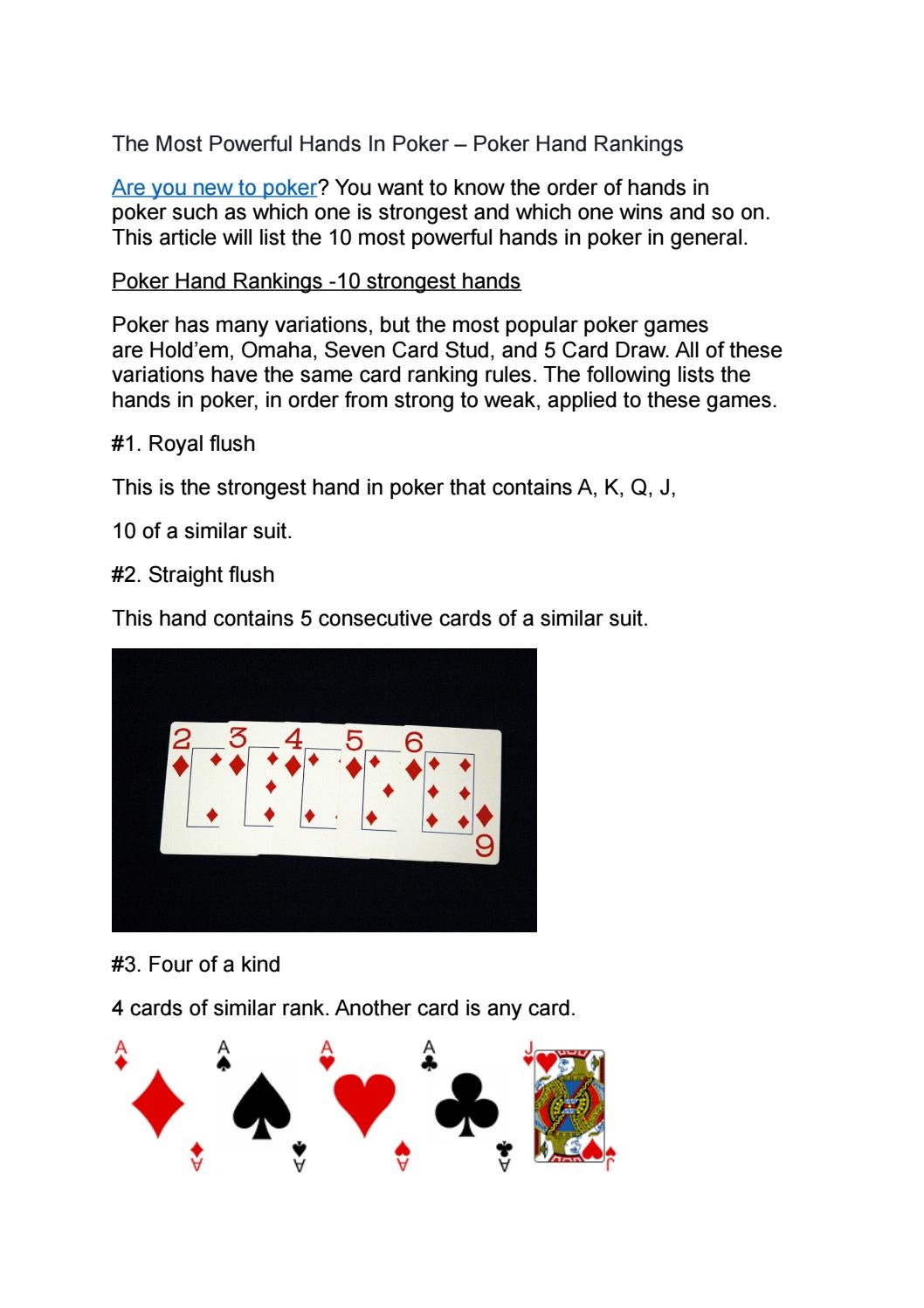
Straight Flush: Five cards in numerical order, all of identical suits.
In the event of a tie: Highest rank at the top of the sequence wins.
The best possible straight flush is known as a royal flush, which consists of the ace, king, queen, jack and ten of a suit. A royal flush is an unbeatable hand.
Four of a Kind:Four cards of the same rank, and one side card or ‘kicker’.
In the event of a tie: Highest four of a kind wins. In community card games where players have the same four of a kind, the highest fifth side card ('kicker') wins.
Full House:Three cards of the same rank, and two cards of a different, matching rank.
In the event of a tie: Highest three matching cards wins the pot. In community card games where players have the same three matching cards, the highest value of the two matching cards wins.
Flush: Five cards of the same suit.
In the event of a tie: The player holding the highest ranked card wins. If necessary, the second-highest, third-highest, fourth-highest, and fifth-highest cards can be used to break the tie. If all five cards are the same ranks, the pot is split. The suit itself is never used to break a tie in poker.
Straight: Five cards in sequence.
In the event of a tie: Highest ranking card at the top of the sequence wins.
Note: The Ace may be used at the top or bottom of the sequence, and is the only card which can act in this manner. A,K,Q,J,T is the highest (Ace high) straight; 5,4,3,2,A is the lowest (Five high) straight.
Three of a kind:Three cards of the same rank, and two unrelated side cards.
In the event of a tie: Highest ranking three of a kind wins. In community card games where players have the same three of a kind, the highest side card, and if necessary, the second-highest side card wins.
Two pair:Two cards of a matching rank, another two cards of a different matching rank, and one side card.
In the event of a tie: Highest pair wins. If players have the same highest pair, highest second pair wins. If both players have two identical pairs, highest side card wins.
One pair:Two cards of a matching rank, and three unrelated side cards.
In the event of a tie: Highest pair wins. If players have the same pair, the highest side card wins, and if necessary, the second-highest and third-highest side card can be used to break the tie.
High card: Any hand that does not qualify under a category listed above.
In the event of a tie: Highest card wins, and if necessary, the second-highest, third-highest, fourth-highest and smallest card can be used to break the tie.
This method of ranking low hands is used in traditional Hi/Lo games, like Omaha Hi/Lo and Stud Hi/Lo, as well as in Razz, the ‘low only’ Stud game.
Note that suits are irrelevant for Ace to Five low. A flush or straight does not ‘break’ an Ace to Five low poker hand. Aces are always a ‘low’ card when considering a low hand.
Please also note that the value of a five-card low hand starts with the top card, and goes down from there.
Five Low, or Wheel: The Five, Four, Three, Deuce and Ace.
In the event of a tie: All Five-high hands split the pot.
Six Low: Any five unpaired cards with the highest card being a Six.
In the event of a tie: The lower second-highest ranking card wins the pot. Thus 6,4,3,2,A defeats 6,5,4,2,A. If necessary, the third-highest, fourth-highest and fifth-highest cards in the hand can be used to break the tie.
Seven Low: Any five unpaired cards with the highest card being a Seven.
In the event of a tie: The lower second-highest ranking card wins the pot. If necessary, the third-highest, fourth-highest and fifth-highest cards in the hand can be used to break the tie.
Eight Low: Any five unpaired cards with the highest card being an Eight.
In the event of a tie: The lower second-highest ranking card wins the pot. If necessary, the third-highest, fourth-highest and fifth-highest cards in the hand can be used to break the tie.
An Eight Low is the weakest hand that qualifies for low in Omaha Hi/Lo and Stud Hi/Lo. However in Razz, there is no such ‘qualifier’ and the lowest hand will always win the pot, even if it is a nine low, queen low, or even a pair!
Omaha Card Rankings Baseball
The Deuce to Seven Lowball hand rankings are the exact opposite of the traditional ‘high’ hand rankings. Therefore, the worst possible hand in traditional high poker – seven-five high, with different suits, becomes the best possible hand in deuce to seven lowball (a ‘perfect seven’ low or ‘wheel’).
In practice, an ace always plays as a high card in Deuce to Seven (so A,5,4,3,2 is an ace high, not a straight). Straights and flushes count against your hand in Deuce to Seven.
Seven Low:Any five unpaired, unconnected cards of different suits, with the highest card being a seven. The best possible hand is 7,5,4,3,2, also known as a ‘wheel’ or ‘number one’.
In the event of a tie: The lower second card wins the pot. Thus 7,5,4,3,2 beats 7,6,5,3,2 (a ‘Seven-Five low’ is better than a ‘Seven-Six low’). If necessary, the third-highest, fourth-highest and fifth-highest cards in the hand can be used to break the tie.
Eight Low:Any five unpaired, unconnected cards of different suits, with the highest card being an eight.
In the event of a tie: The lower second card wins the pot. If necessary, the third-highest, fourth-highest and fifth-highest cards in the hand can be used to break the tie.
Nine Low:Any five unpaired, unconnected cards of different suits, with the highest card being a nine.
In the event of a tie: The lower second card wins the pot. If necessary, the third-highest, fourth-highest and fifth-highest cards in the hand can be used to break the tie.

Ten Low:Any five unpaired, unconnected cards of different suits, with the highest card being a ten.
In the event of a tie: The lower second card wins the pot. If necessary, the third-highest, fourth-highest and fifth-highest cards in the hand can be used to break the tie.
Note: There is no ‘qualifier’ for low in Deuce to Seven lowball games. The above are just examples of hands that may come up in play – the lowest hand will always win the pot in Deuce to Seven, even if it is a pair or worse!
Badugi does not use traditional poker hand rankings and it takes some practice to learn how to correctly read the hands. Badugi hand rankings are somewhat related to the Ace to Five rankings; like in Ace to Five, an ace always plays as a low card. However, unlike Ace to Five, each card in your hand must be a different suit and a different rank, in order to count.
Badugi hands consist of four cards, instead of the usual five. Because of this it is impossible to make a five-card straight, and having four cards in sequence does not hurt your hand.
Remember, if you have cards of the same suit, only one of them counts, and if you have pairs, only one of them counts.
Badugi: A badugi is any hand which consists of four unpaired cards, each a different suit.
Omaha Card Rankings Football
In the event of a tie: The lower second card wins the pot. If necessary, the third-highest and fourth-highest cards in the hand can be used to break the tie.
Three-Card Hand: Any hand consisting of three unpaired cards of different suits, but a fourth paired or suited card. The lowest three unpaired cards of different suits play.
Because there is a pair, one of the fours does not count, so it is simply ignored, making a 4,2,A three-card hand
Because there are two hearts in this hand, one of them is ignored, making a 3,2,A three-card hand.
In the event of a tie: The lower second card wins the pot. If necessary, the third-highest card in the hand can be used to break the tie. The fourth (paired or suited) card does not count toward the hand and is not used to break ties.
Two-Card Hand: Any hand consisting of two unpaired cards of different suits, but two paired or suited cards. The lowest two unpaired cards of different suits play.
Because there are two pairs, one of each pair is discarded, making a 5,A two-card hand.
Because there are three hearts, two of them are discarded, making a 2,A two-card hand.
In the event of a tie: The lower second card wins the pot. The third and fourth (paired or suited) cards do not count toward the hand and are not used to break ties.
One-Card Hand: A hand consisting of only one playable card. The lowest card plays.
Since there are four Aces, three of them are discarded, making a one-card hand of just an Ace.
Since there are four cards of the same suit, three of them are discarded, making a one-card hand of just a Three.
Omaha Card Rankings 2020
In the event of a tie: The pot is split between two equal one-card hands.
Omaha Card Rankings 2019
The poker dictionary is your reference for poker jargon and the language of poker.
Make your first real money deposit and start playing at PokerStars. Deposits are fast and secure.