Best To Worst Hands In Texas Holdem
- Best Texas Holdem Hand
- Best To Worst Hands In Texas Hold'em
- Texas Holdem Odds Chart
- Texas Holdem Hand Rankings Preflop
This chart will give you the rank of Texas Hold’em hands from best to worst. This can serve as an easy list of all hands sorted by strength rather than separated by biggest starting card. I am including all 13 pocket pairs and 78 unique non-paired starting hands for a total of 91 hands.
A pair of aces, also known as 'pocket rockets' (and sometimes 'American Airlines') is the best starting hand for Texas Hold 'em. Be wary of how many other players enter the pot, as more players increase the likelihood of someone beating your aces. You have the best pocket cards, but you can still lose to two pairs of any other cards. A combination of 2 and 7 different suits is considered the worst hand in Texas Hold'em. These are the 2 lowest cards from which it is impossible to make a straight (4 cards between 2 and 7). In a regular full-table game, the answer is the dreaded 2-7 offsuit. This hand plays the worst at a table full of players. There are 169 different hand combinations (ignoring the different suits) that you can be dealt in Texas Hold'em. The very best hand, of course, is pocket Aces (A-A).
Based on the tabulated data and chart generated, there are a few interesting observations to be made. The are listed below:
1. Pair A is best hand
There should be no surprise that Pair A is the best hand. Having a pair A, helps you to easily get the best possible double pair combo or three-of-kind combo. While it might be harder to strike straight or flush with it, those scenarios are typically less likely to happen. Thus, making pair A better in general.
2. Offsuit 72 is the worst hand
This might be less known to people and it could be counter intuitive. Some might have thought that perhaps Offsuit J2 would be worse than Offsuit 72. But, that is not the case.
To understand why this is the case, we can start thinking about what are combinations that are most likely to lead to a winning combo assuming no one folds. Given any hands, we are more likely to win with double pair, followed by 3-of-a-kind, straight flush and so forth.
With offsuit 72, we are more likely to win double pair of pair 7 and pair 2, followed by three-of-a-kind and so on. However, it is also worthwhile to note that it is highly like other players has a better double pair or three-of-a-kind. This bring us to the next important lesson to learn.
3. Having a suited, closely connected hand with A, K or Q is better than having pairs that is less than 9
If you were to investigate the table or chart, the hand ranked 5th is Suited AK. What is even more interesting is pairs hand only took 6 spots from rank 1 to rank 20. Most of the remaining spots were taken up by suited, closely connected hands with a high card like A, K or Q.
The reason for this is similar to previous point that we made. It is more frequent that players will win using double pairs or 3-of-a-kind. Therefore, having a higher card helps to push you to a better standing to win.
One final note on this topic - Pair 9 is the last pair hand ranked in the top 20 hands. Playing any other pairs hand may not be as good as conventional wisdom might suggest.
4. Winning chance drops fast within the top 7 ranked hands
This is the lesson that really took us by surprised. While developing our poker odds calculator, we did had a sense that odds of winning was somewhat asymmetric. But, the chart above really solidify how much the asymmetry was.
Within the top 7 ranked hands, the probability of winning drops really fast from paired A to paired K and so forth. If you get the top 7 hands, you really should work hard to get through the preflop.
5. You are more likely to win a 6 players match than a 9 players one
A player with hands that are in the top 7 ranks in a 6 players game have a much better chance of winning in a 9 players game. For example, Paired A has roughly 49.5% preflop winning probability in a 6-player game compared to only 35% in a 9-players game. While 14.5% difference is not as big as it sounds, it has a significant impact on the pot odds that you will need to make a value play. In short, it might be easier to make money off a 6 players game rather than a 9 players game.
6. In a no-folding six players match, your hand range to play is very large
This point is not as crucial as other points we have made. But, we find this observation quite interesting although it is unlikely to happen in real life.
Suppose that we are in a no-folding 6 players Texas Hold'Em match. During every betting session, our pot odds is 5-to-1. This means that for every $1 we bet, we stand to win $5.
Based on this pot odds, our break-even pot equity or winning odds is around 16.67%. Using the chart above, we can see that we can play any hands better than rank 106. This means that players can play 105 types of hands out of 169 types (59.2% of all types) and still perform better than break even! Basically, you have a very large hand range to play in this type of situation.
Nonetheless, this is a just-for-fun analysis, which does not happen that often in real life. Based on some of our experience playing, it could happen sometimes during preflop though.
7. Our hand rankings are similar to Sklansky hand groups
Sklansky hand groups was formulated by David Sklansky and Mason Malmuth. Both of these old school poker players understand the math very well. It is no surprise that our hand rankings aligns very well with their proposed hand groups.
Sklansky hand group proposes that Tier 1 group consists of pair A, pair K, pair Q, pair J and suited AK. These cards are essentially ranked 1 to 5 via our Monte Carlo simulation. The same observation can be made for Sklansky Tier 2 and Tier 3 hand group.
These days, even the most casual of poker fans who might happen upon a WSOP broadcast during the summer knows that the best Texas Hold’em starting hand is pocket aces. With an additional 1,300+ potential starting hand combinations, however, the overwhelming majority of the hands you’ll be dealt will consist of inferior holdings. As such, it is best to know how to deal with other card combinations that might come your way.
Sometimes the cards you’re dealt will look appealing and you’ll want to play them. Think a couple face cards, perhaps. Maybe you’ve gotten a couple of connected cards or maybe they’re suited (BUT THEY WERE SUITED!). In most situations, you’ll find that pairs are at least somewhat playable but for all those other hole card combos you’ll get, just like Kenny Rogers’ famous song “The Gambler” advises, “you’ve got to know when to hold’em, and know when to fold ’em.”
The more easily you’re able to identify weak starting hand combos, the quicker you’ll be able to make the right decisions at the table. When to bet, raise, call… or throw your hand away. The easiest decision you’ll usually have is throwing away your hand when it’s quite literally one of the worst combinations possible.
So, without further ado, we present to you the worst Texas Hold’em starting hands.
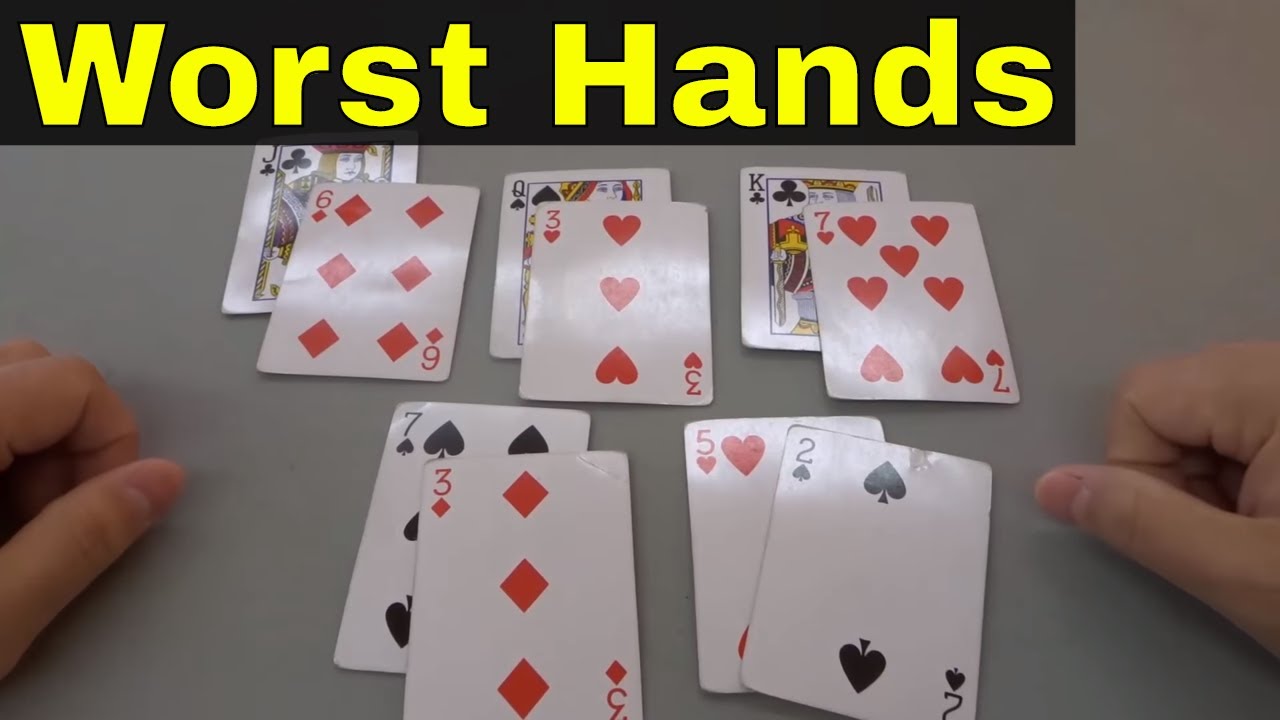
Deuce-Seven
Holding a 2 and a 7 (off suit) as your starting hand is without a doubt the worst hand you can get dealt. At best, you’d realistically be hoping to catch a 2 or 7 among the community cards on the flop for a low pair, which still makes for a relatively weak hand to carry on with. In pretty much every scenario then, whether you’ve found yourself a seat at the live casino card games or at your friend’s Friday home poker table, folding is the way to go when dealt the dreaded Deuce-Seven.
Deuce-Eight
The same issues that arise with the previous card combination are present at this one. In fact, it’s only marginally better. Should you decide to go against conventional wisdom and choose to proceed with such holdings, even if you improve to a pair on the flop, you’ll almost always find yourself behind and needing additional help to improve versus your opponents. Save yourself the hassle – and the money! – and get rid of the Deuce-Eight as quickly as you can… yes, even if they’re suited.
Three-Seven and Three-Eight
At this point, you probably know the drill. Starting hand combinations of 3-7 and 3-8 are, indeed, better than the aforementioned couple of combinations. The only advantage these combinations have over the ones we’ve listed already is that there’s an outside chance you might hit an inside straight with precisely the right flop. That, however, is most certainly NOT a reason to hold on to these starting hands. If you’ve got any interest in protecting your poker bankroll, toss the cards into the muck.
Deuce, Three, or Four and a Nine
Best Texas Holdem Hand
You pick up your hole cards and start to peel… the first card you see is a 9. Not great, but not horrible either. Then you lift up the second card ever so slightly to reveal… a 2, or a 3, or a 4. The disappointment you feel should be palpable. Even if you’re no math expert and don’t realize that the chances of you winning with a starting hand of that nature are very slim, that sinking feeling you got when discovering that second card ought to lead you to do the right thing, namely chuck the hand.
Best To Worst Hands In Texas Hold'em
Conclusion
We’re pretty sure you’ve gotten the picture by now. It doesn’t take a card sharp to realize that while many of the hands you’ll be dealt aren’t too great to start out with, some of them are just pure rubbish and out to be discarded.
Texas Holdem Odds Chart
So there you have it, a rundown of some of the worst possible starting hand combinations you can possibly be dealt in Texas Hold’em. Hopefully, this is the only place you’ll ever have to see such trashy cards, and the dealers will always send premium hands your way.
Other Posts You'll Enjoy
Texas Holdem Hand Rankings Preflop
- Top 10 starting hands in Texas Hold 'Em
This post lists and expands on the top 10 starting hands in Texas Hold 'Em. Many beginners to the game start out learning these hands…
- Texas Hold’em – A Guide
It has been described as the “Cadillac of Poker” by the godfather of the game, Doyle Brunson. No-limit Texas hold’em is the main game played…
- How Does Open-Face Chinese Poker Differ from Hold’em?
In this poker tips and strategy post, we list and then elaborate on the main differences between Texas Hold'em and Open-Face Chinese Poker. It's the…
- Summary of Poker
Hello World! We've decided to launch a brand new poker blog - hopefully one day we'll be a big website visited by thousands of people.…
- 3 Awesome Poker Variants You Need to Learn
Even the most passionate of poker players are eventually likely to get bored playing solely Texas Hold'em and Omaha. Isn't it wonderful, then, that there…